In Elko!
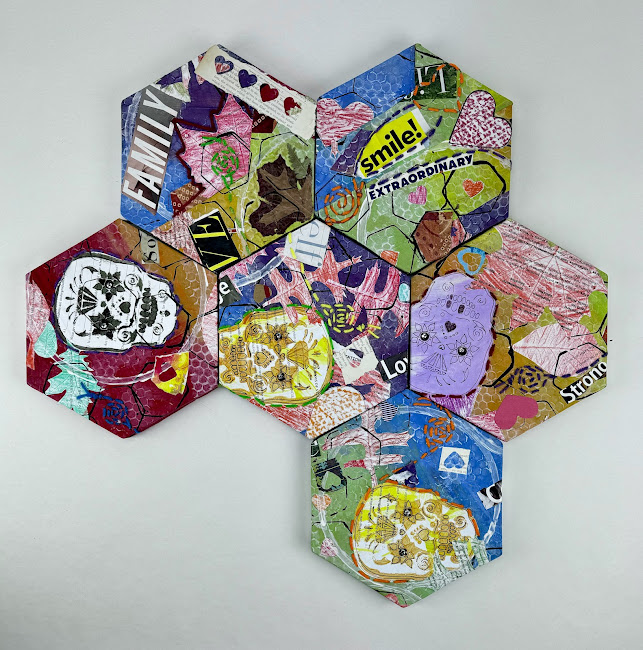
In the spring of 2026, visitors walking into the Leonard Student Center at Great Basin College in Elko, Nevada, encounter something that feels less like a conventional art exhibit and more like stepping inside a living metaphor. Mounted across the walls is the Honeycomb Project, a sprawling installation made of countless wooden hexagons, each one its own tiny artwork, all fitting together into a single, intricate whole. The effect is at once visually striking and quietly symbolic: it suggests that community is not a vague idea, but something you can literally see, tile by tile.

The Honeycomb Project is the brainchild of Nevada artist and educator Candace Garlock, who has spent years exploring how collaborative art can knit together people and places. Her earlier project, “NV Awe: Tiny Treasures,” invited participants to transform small wooden discs into miniature celebrations of Nevada; the enthusiastic response to that effort became the seed for this larger, more ambitious honeycomb concept. In the current project, Garlock and her collaborators use the six‑sided form as a framework for connection: each participant designs a single hexagon, but none of the pieces make full sense in isolation. Only when assembled do they reveal the density and diversity of the community that produced them.

At Great Basin College, the Honeycomb Project is on view for the entire spring 2026 semester, from January 12 through June 8, turning the student center into a temporary hive of creativity. The installation is supported by the college’s Humanities Center, which has built a series of events around it: an artist talk with Garlock in late February invites students and community members to hear the story behind the project, while a hands‑on Gelli‑printing workshop offers a chance to experiment with the same playful, layered techniques that appear on many of the hexagonal tiles. These events underscore that the Honeycomb Project is not just something you look at—it is something you can enter into, learn from, and help sustain.
 |
| Photo taken by Jeremy Ellis, Great Basin College |
What makes the Honeycomb Project especially compelling is its geographic and social reach. The hexagons on the walls in Elko are not solely local; they come from artists, students, and workshop participants scattered across Nevada and into neighboring states like Idaho and California. Many were created in community or classroom workshops at colleges and art centers, so each cluster of tiles carries traces of the specific group that made it—their color choices, their stories, their shared experiences. Seen together, the installation functions as a visual map of relationships: a reminder that rural campuses, urban galleries, and small towns are all part of the same creative ecosystem.honeycomb2025.

Photo taken by Jeremy Ellis, Great Basin College


Comments
Post a Comment